Uninsured/Underinsured Motorist Coverage for Riders: Why It Matters
You did everything right and still got hit — by someone with no insurance. UM/UIM is the coverage that pays for your injuries when the at-fault driver can't. Here's how it works and why riders weigh it differently.
Uninsured/underinsured motorist (UM/UIM) coverage pays for your injuries — medical bills, lost wages, sometimes property damage — when the driver who hit you has no insurance or not enough of it. Your own insurer steps into the at-fault driver’s shoes, up to your UM/UIM limit. For riders, it’s the single most body-focused coverage you can buy.
Key takeaways
UM/UIM protects the rider, not the bike. It pays your medical bills and lost wages when the at-fault party can’t.
Uninsured = they have nothing. Underinsured = they have too little. Two halves of one coverage, and the second half matters more than riders think.
On a bike, the injury math is different — the rider’s body absorbs what a car’s structure would, so medical exposure runs higher.
Your UM/UIM limit caps your own recovery — it’s the one limit that protects you directly.
Some states mandate it or require written rejection — check your state’s rules rather than assuming it’s optional.
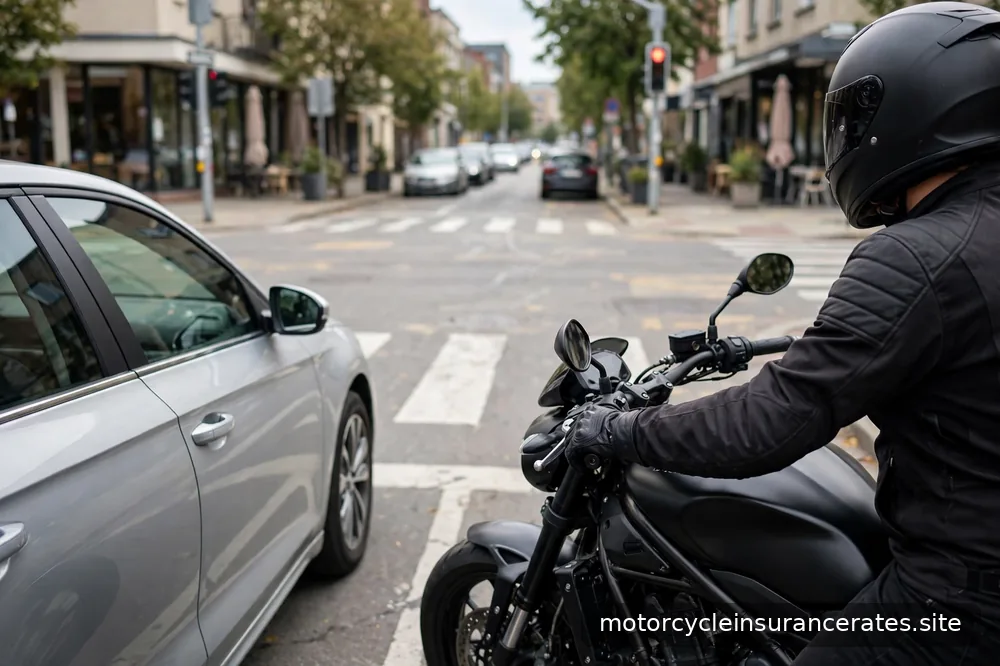
You’re stopped at a red light, doing everything right — helmet on, gear on, positioned visibly. The driver behind you is looking at a phone, doesn’t brake in time, and hits you at full speed. You’re thrown, the bike is wrecked, and you’re looking at surgery and months off work.
Then the second blow lands: the driver has no insurance. None. Or the legal minimum from a decade ago, exhausted by the ambulance ride.
Your liability can’t help — it only pays other people. Collision covers the bike (minus deductible). Health insurance covers some medical bills (minus deductibles and copays). But lost wages, ongoing rehab, the damages liability would have paid? Without UM/UIM, you’re pursuing an uninsured driver personally — and people who drive without insurance rarely have assets worth pursuing.
UM/UIM exists for exactly this gap. Your own insurer steps into the shoes the at-fault driver’s insurer should have filled, and pays what their liability would have paid — up to your UM/UIM limit. The Insurance Information Institute describes it plainly: UM/UIM pays for damages to you and your property caused by a driver with no insurance or inadequate insurance, typically covering medical treatment, lost wages, and in some cases property damage. (Source type: industry educational body — III)
It’s the coverage for the crash that isn’t your fault and the driver who can’t pay. On a motorcycle, that combination is worth thinking about carefully.
Uninsured vs. underinsured: the two halves
The name has two parts because the problem has two parts:
Uninsured motorist (UM) responds when the at-fault party has no insurance — lapsed, cancelled, never purchased. It also typically covers hit-and-run crashes where the driver can’t be identified. (Bike damage in a hit-and-run usually goes through collision; injuries go through UM.)
Underinsured motorist (UIM) responds when the at-fault party has insurance, but their limits run out before your losses do. This is the half riders underestimate. Minimum-limits drivers are legal and everywhere; a serious injury blows past minimum bodily-injury limits fast. UIM pays the difference between their limit and your actual losses, up to your UIM limit.
How UIM interacts with their payment varies by state — in some it stacks on top of their limit (“excess”), in others it fills up to your limit (“offset”). The distinction changes the math, so learn your state’s version.
A common structure: many policies sell UM and UIM together as one line with one limit; some states split them. Ask your agent which structure yours uses.
The liability that you owe others is the mirror image of this coverage. Our motorcycle liability coverage explainer covers that side — what you pay when you’re at fault.
What UM/UIM actually pays
UM/UIM is designed to replicate what the at-fault driver’s liability would have paid if they’d been properly insured. That means:
Medical treatment. Emergency care, surgery, hospitalization, rehabilitation, ongoing therapy — the full arc of injury treatment, up to your limit. This is the core of the coverage and the reason it exists.
Lost wages. Income you lose while injured and recovering. For riders who work with their hands, ride for a living, or lack generous sick leave, this component can rival the medical bills.
Pain and suffering. The non-economic component — what liability would have paid beyond the bills. Availability varies by state law.
Property damage (sometimes). In some states and policies, UM includes property-damage coverage for your bike; in others, your bike’s damage goes through collision instead. Know which version you have — don’t discover it after a hit-and-run.
Funeral expenses. In the worst case, UM/UIM can cover fatal-crash expenses that the at-fault party’s nonexistent insurance can’t.
What it doesn’t do: pay for injuries you cause to others (that’s your liability), cover your bike’s crash damage when you’re at fault (that’s collision), or respond to intentional acts. It’s strictly the “someone else hit me and can’t pay” coverage.
Why riders weigh it differently than drivers
Car drivers buy UM/UIM too, but the calculus hits differently on two wheels. Four reasons:
1. The injury exposure is structurally higher. In a car, the vehicle’s structure absorbs enormous energy before the occupant is hurt. On a bike, the rider is the crumple zone. The same impact that totals a sedan’s bumper puts a rider in trauma care. Higher medical exposure means the at-fault party’s limits run out faster — which is exactly when UIM matters.
2. You’re more exposed to others’ mistakes. Riders are harder to see, and “I didn’t see the motorcycle” is the most common sentence in crash reports. A meaningful share of multi-vehicle motorcycle crashes are the other party’s fault.
3. Lost wages hit harder. The injuries are worse, the recovery is longer, and many riders work jobs where physical capability is the job. The wage-loss component of UM/UIM carries weight it doesn’t for a desk worker with a sprained wrist.
4. It’s inexpensive relative to the protection. UM/UIM is consistently among the least expensive line items — the insurer prices the low probability of paying it. Low probability, catastrophic severity: precisely what insurance exists for.
None of this is an argument that every rider must max out UM/UIM. It is an argument that the line item deserves more than the two seconds most riders give it at purchase — it’s the one coverage on the policy whose limit protects you directly.
How the whole policy fits together around this coverage — and what each part costs you to carry — starts with our cornerstone what motorcycle insurance is.
How the claim works in practice
A UM/UIM claim has a particular shape worth understanding before you need it:
Step 1: Establish the other party’s status. Your insurer verifies the at-fault driver is actually uninsured (or underinsured) — through their insurer, state databases, or the lack thereof. Hit-and-run claims need a police report documenting the unknown driver; without it, the claim gets difficult.
Step 2: Your insurer becomes the adversary. You’re claiming against your own insurer, which now plays the role the at-fault driver’s insurer would have played — investigating, questioning, negotiating. Document everything as if dealing with a stranger’s insurer, because functionally you are.
Step 3: Prove your damages. Medical records, bills, wage documentation, evidence of ongoing impact — the same proof package a liability claim would require. The insurer evaluates what the at-fault party would have owed, then pays up to your UM/UIM limit.
Step 4: The offset calculation. What the at-fault driver’s insurer already paid gets credited — you don’t get paid twice for the same loss. If they paid $25,000 and your UIM limit is $100,000, the available UIM is generally up to $75,000 in offset states.
Step 5: Settlement and release. Like any injury claim, settlement typically waits until treatment stabilizes, and signing a release closes the claim. Don’t sign while treatment is still evolving without understanding what you’re giving up.
Stacking (where allowed). Some states allow combining UM/UIM limits across multiple vehicles on your policy — two bikes at $50,000 each could mean $100,000 effective. Availability varies; ask, don’t assume.
Every other limit on your policy protects someone else. Your liability limit protects your assets from others’ claims. Your UM/UIM limit is the one that protects you — which makes it the limit to think about most personally.
Match it to your liability limits. The most common guidance agents give (as a starting point, not advice): carry UM/UIM at the same level as your bodily-injury liability. The logic is symmetry — you value your own injuries at least as highly as a stranger’s. Many riders carry lower UM/UIM than liability without ever deciding to; check whether yours match.
Think about your health insurance gaps. High deductibles, limited networks, no disability coverage — every gap is one UM/UIM would fill after a crash.
Think about your income. Two months off work means different things at different incomes and different sick-leave policies. The wage-loss component scales with your actual earnings — run your own numbers.
State minimums for UM/UIM (where mandated) are floors. A few states require UM/UIM at minimum levels; the minimums keep you legal, not protected. The adequacy question is yours to answer with your agent.
Revisit after life changes. New job with less sick leave, a mortgage that needs your income, a health plan with a higher deductible — all of these quietly raise the stakes of your UM/UIM limit. Review it when life changes, not just at renewal.
Frequently asked questions
Is UM/UIM required?
It depends on the state. Some states mandate it, some require you to reject it in writing (which tells you something about how seriously they take it), and some leave it fully optional. Check your state’s current rules — and treat “optional” as a decision, not a default.
Does UM/UIM cover my passenger?
Generally yes — UM/UIM typically covers injuries to passengers on your bike when an uninsured/underinsured driver causes the crash, up to the policy’s per-person and per-accident limits. Confirm the details in your state’s version and your policy language.
What’s the difference between UM and UIM in practice?
UM is for the driver with no insurance (or a hit-and-run ghost); UIM is for the driver whose limits run out before your bills do. You file UM when there’s nothing to collect from; you file UIM after collecting their limit and finding it insufficient.
Will my own insurer really fight my UM claim?
They’ll evaluate it the way any insurer evaluates a claim against it — which means documentation and negotiation, not automatic payment. It’s your contract and they’re bound by it, but approach the claim with the same rigor you’d bring against a stranger’s insurer.
Can I stack UM/UIM across my bikes?
In some states, yes — stacking combines the UM/UIM limits of multiple insured vehicles. Availability depends on state law and your policy language. Ask your agent; it’s a question with a definite answer for your situation.
Your concrete next step
Find your UM/UIM limit on your declarations page and compare it to your bodily-injury liability limit, side by side. If UM/UIM is lower — and for many riders it is — ask yourself whether that ordering reflects a decision you actually made, or a default you never noticed. Then take that question to a licensed agent. It’s a five-minute conversation that covers the most body-focused line on your policy.
Motorcycle Insurance Compass publishes general educational information about insurance. Nothing here is insurance, legal, or financial advice for your situation. Policy language varies by insurer and state — read your own policy and talk to a licensed agent about your specific needs.