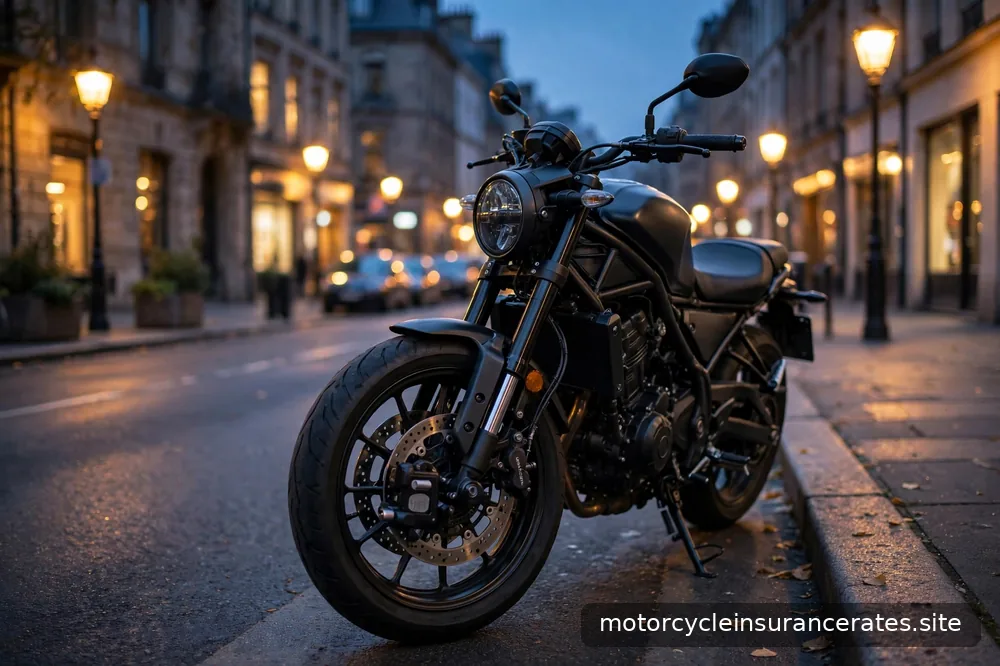
Collision vs. Comprehensive for Motorcycles: Which Protects Your Bike
Two coverages, one bike, endless confusion. This side-by-side guide runs real scenarios — crash, theft, hail, deer strike — through collision and comprehensive so you always know which one answers.
Collision covers damage to your bike from crashing into another vehicle or object. Comprehensive covers damage from everything else — theft, fire, hail, vandalism, animal strikes. Both pay your bike’s book value minus your deductible, both are optional on a paid-off bike in most states, and neither covers your injuries or other people’s losses.
Collision pays when your bike hits something. Comprehensive pays when something happens to your bike without a crash.
That’s the whole distinction, and it resolves nearly every “which coverage?” question riders argue about. Bike meets guardrail → collision. Bike meets thief in the night → comprehensive. Bike meets hailstorm → comprehensive. Bike meets the back of an SUV → collision.
The Insurance Information Institute defines them the same way: collision covers damage to your motorcycle from a collision with another vehicle, while comprehensive pays for damage from events other than collision — fire, theft, vandalism — with the insurer paying book value minus deductible in both cases. (Source type: industry educational body — III)
Both are first-party coverages: they pay you (well, they pay for your bike), unlike liability which pays others. Both are optional in most states on a bike you own outright. And both share the same payout formula — which is where riders should look next.
Collision, in detail
Collision covers damage to your motorcycle when it collides with another vehicle or an object — a car, a guardrail, a tree, the pavement itself in a single-vehicle crash. The trigger is impact.
Payout math: the insurer pays the lesser of the repair cost and the bike’s pre-crash book value, minus your deductible. If repairs cost $2,500 and your deductible is $500, the insurer pays $2,000. If the bike is totaled — repairs approaching or exceeding book value — the payout becomes the book value minus your deductible.
What “book value” means for you: the bike’s current market value, not its sticker price. A three-year-old bike is worth less than you paid; the policy insures today’s value. Riders who owe more than book value (common early in a loan) face a gap between the payout and the loan balance — that’s what gap coverage addresses, and it’s a loan-structure issue worth understanding before you need it.
Single-vehicle crashes count. This surprises riders who think “collision” means “collision with a car.” Lowside into a ditch, clip a guardrail, drop it avoiding a dog — if the bike hit something (including the ground), it’s a collision claim.
Hit-and-run by an unknown driver: your bike’s damage typically goes through your collision (deductible applies); your injuries may go through UM/UIM. The unknown driver can’t pay, so your own policy does.
Fault doesn’t block collision. Collision pays regardless of who caused the crash — that’s the point of first-party coverage. Your insurer may then pursue the at-fault party’s insurer (subrogation), occasionally returning your deductible.
Where collision sits in the whole policy — and how a claim moves from crash to check — is walked through in how motorcycle insurance works, which follows one hypothetical claim through every stage.
Comprehensive, in detail
Comprehensive covers damage from events other than a collision. The classic list, straight from the III definition: fire, theft, vandalism — plus the ones riders actually meet: hail, falling branches, flood, and animal strikes.
Payout math: identical to collision — repair cost or book value, whichever is lower, minus your comprehensive deductible. Many riders carry a lower comprehensive deductible than collision deductible, because comprehensive claims tend to be smaller and more frequent (a stolen bike excepted).
Theft is comprehensive’s headline risk for riders. Motorcycles are uniquely stealable — two people and a van, no alarm standard on many bikes. Street-parked bikes in urban areas are the highest exposure. Comprehensive is the only coverage that responds to theft, full stop.
Animal strikes are comprehensive, not collision — even though it feels like a crash. Hit a deer and the claim goes through comprehensive. This is one of those definitional quirks worth knowing before it happens, because riders instinctively file it wrong.
Weather and falling objects. Hail dents tanks and cracks windscreens; a branch totals a parked bike; a garage fire takes everything. None involve the bike hitting anything, so all are comprehensive.
Vandalism and riot. Slashed seat, keyed tank, tipped-over bike in a parking lot — comprehensive. (A bike tipped over by a hit-and-run vehicle starts to look like collision; the adjuster sorts the mechanism.)
Glass and small stuff. Cracked windscreen from road debris, broken mirror from a parking-lot encounter — comprehensive handles these, though many riders pay small ones out of pocket rather than filing (more on that under deductibles).
Six scenarios: which one pays
Scenario
Coverage
Why
You rear-end a car at a light; your front end is smashed
Collision
Your bike hit another vehicle
Bike stolen from your apartment parking lot overnight
Comprehensive
Theft, no crash involved
Hailstorm dents the tank while parked at work
Comprehensive
Weather event, no crash
You lowside on gravel and slide into a guardrail
Collision
Bike hit an object (and the ground)
Deer runs into your path at dusk; you hit it
Comprehensive
Animal strike is defined as comprehensive
Vandal keys your tank and slashes the seat
Comprehensive
Vandalism, no crash
Two edge cases riders ask about constantly:
“Someone knocked my parked bike over and drove off.” If a vehicle hit it, that’s collision (your policy pays, deductible applies). If a person pushed it over, that’s vandalism — comprehensive. Report what you know; don’t guess the mechanism.
“A rock cracked my windscreen.” Road debris striking the bike is comprehensive — the bike didn’t collide with anything. Small, common, and why many riders carry a low comprehensive deductible.
The pattern to internalize: ask what moved. If the bike moved into something → collision. If something happened to the bike while it wasn’t crashing → comprehensive.
What neither covers
The boundary lines both coverages share:
Your injuries. Neither touches your body. Health insurance, MedPay, or UM/UIM handle the rider.
Other people’s losses. That’s liability’s job, always. Collision and comprehensive never pay third parties.
Custom parts beyond factory equipment. This is the big one riders miss. III notes that many collision and comprehensive policies cover only factory standard parts or limit add-on coverage — your chrome, custom paint, saddlebags, and aftermarket exhaust are typically valued as stock unless you carry custom parts/equipment coverage. Our deep dive on custom parts, gear, and accessories maps this gap completely.
Wear, maintenance, and breakdown. Worn tires, a tired chain, an engine that finally gives up — insurance covers sudden accidental loss, not the slow kind.
Intentional damage. Your own deliberate acts are excluded, as everywhere in insurance.
Racing and stunts. Standard policies typically exclude competition and stunt riding from all coverages — the exclusion isn’t limited to liability.
Diminished value (usually). After a repaired crash, the bike may be worth less than before. Most motorcycle policies don’t pay diminished value.
Deductibles: the decision that matters
Choosing between collision and comprehensive gets the attention; choosing your deductibles moves more money. The deductible is the knob that trades premium against out-of-pocket risk, and it’s worth thinking about deliberately.
How the trade works. Higher deductible → lower premium, but more out of pocket when you claim. Lower deductible → higher premium, less shock at claim time. There’s no universally right answer — it’s a question about your cash reserves and your risk tolerance, not a moral one.
Split them. Many riders carry a higher collision deductible and a lower comprehensive deductible: collision claims tend to be big (the deductible barely matters on a $4,000 repair), while comprehensive claims are often small (a low deductible makes a cracked windscreen worth filing).
The small-claim trap. Filing a $400 claim against a $500 deductible pays you nothing and still puts a claim on your record. Damage near or below your deductible should come out of pocket — that’s what the deductible is for.
Lender caps. Financed the bike? Your loan may cap how high your deductibles can go — the lender won’t let you carry a $2,500 deductible on their collateral. Check the loan terms before raising deductibles.
Revisit yearly. Deductibles should track the bike’s value. A $1,000 deductible on a $12,000 bike is reasonable; the same deductible on a $2,500 bike means you’re barely insured. As the bike depreciates, the math changes.
When riders skip one (and the trade-off)
Dropping collision or comprehensive is a legitimate choice in some situations — as long as it’s a decision, not an oversight.
The case for dropping collision: your bike’s book value is low enough that a payout (book value minus deductible) wouldn’t meaningfully help you replace it. If the bike is worth $2,000 and your deductible is $1,000, you’re paying premium for at most $1,000 of protection. Some riders self-insure at that point — deliberately, with eyes open.
The case for keeping comprehensive: it’s usually the cheaper of the two, and theft doesn’t care about book value — a stolen $2,000 bike is a $2,000 loss with zero recovery. Riders who drop collision often keep comprehensive for exactly this reason.
The case against dropping either on a financed bike: you usually can’t — the lender requires both. And even where you technically could, the gap between loan balance and book value makes it reckless.
The winter question: rather than dropping coverage seasonally, look at lay-up options that keep comprehensive active while suspending the rest. Cancelling outright creates a lapse and leaves theft and fire uncovered.
The honest test: for each coverage you’re considering dropping, ask “if this exact loss happened tomorrow, could I write the check myself without real pain?” If yes, skipping is rational. If the question makes your stomach drop, keep the coverage.
Whatever you decide about collision and comprehensive, the mandatory core stays the same — our motorcycle liability coverage guide explains the coverage every rider carries and what it pays.
Frequently asked questions
Do I need both collision and comprehensive?
Legally, no — neither is state-mandated on a paid-off bike. Practically, they cover completely different risks (crash vs. theft/weather), so dropping one leaves a specific hole. Lenders require both on financed bikes.
Which deductible should I choose?
There’s no universal answer — it’s a trade between premium and out-of-pocket risk. Common practice is a moderate-to-high collision deductible and a lower comprehensive deductible. The key rule: never carry a deductible you couldn’t comfortably pay tomorrow.
Does comprehensive cover a crash with a deer?
Yes — animal strikes are defined as comprehensive claims, even though it feels like a collision. File it as comprehensive.
If my bike is totaled, do I get what I paid for it?
No — you get the pre-crash book value minus your deductible. New-bike price is irrelevant unless you carry agreed value coverage. This surprises riders more than almost anything else.
Will filing a small comprehensive claim raise my rates?
Comprehensive claims are generally treated more leniently than at-fault collision claims, but any claim goes on your record and rating varies by insurer. Don’t file near or below your deductible.
Your concrete next step
Look at your declarations page and write down three numbers: your collision deductible, your comprehensive deductible, and your bike’s approximate book value (look it up — don’t guess). Divide each deductible by the book value. If either ratio looks absurd — a $1,000 deductible on a $2,500 bike — you have a coverage decision to make, and now you have the numbers to make it with.
Motorcycle Insurance Compass publishes general educational information about insurance. Nothing here is insurance, legal, or financial advice for your situation. Policy language varies by insurer and state — read your own policy and talk to a licensed agent about your specific needs.