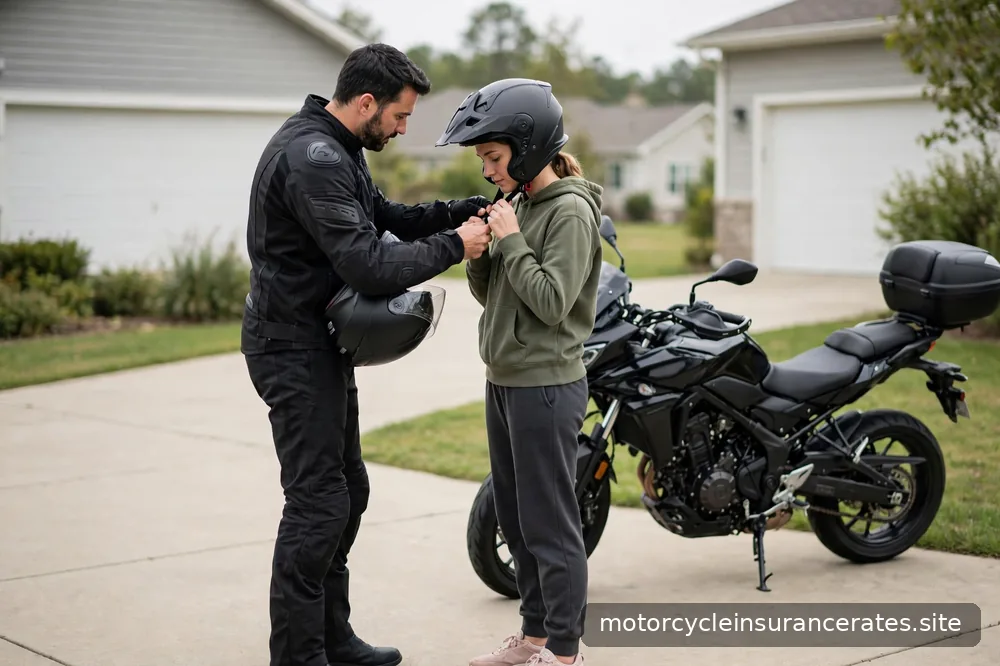
Guest Passenger Liability: What Riding Two-Up Means for Insurance
Riding two-up adds a second person to your risk picture. This guide explains guest passenger liability — what it pays, where it varies by state and insurer, and the questions to ask your agent before you carry a passenger regularly.
Guest passenger liability is the part of a motorcycle policy that can pay for a passenger’s injuries when you are at fault in a crash. It is not automatic everywhere — availability and rules vary by state and insurer. Before you regularly ride two-up, you need to know whether your policy includes it and what it actually covers.
Key takeaways
Guest passenger liability protects your passenger, not you. It pays for injuries your passenger suffers when you are legally at fault.
It is not standard in every state or with every insurer. Some policies include it, some exclude it, and some require it to be added.
Your own liability coverage is a separate thing. Liability pays people outside your bike; guest passenger coverage addresses the person riding behind you.
Uninsured motorist coverage is the other half of the picture. It protects both of you when the other driver is at fault and can’t pay.
Ask before you ride two-up regularly. A five-minute call to your agent beats discovering an exclusion after a crash.
Every motorcycle policy has a liability section. That section pays for injuries and property damage you cause to other people — the driver you rear-end, the pedestrian you clip. Your passenger sits in a gray zone: they are not exactly “you,” but they are not exactly “the other people” either. Guest passenger liability exists to close that gap.
In plain terms, it is coverage that responds when your passenger is injured in a crash where you are at fault, and they (or their family) seek compensation from you. Think of the scenario honestly: you misjudge a curve, the bike goes down, and your passenger breaks a collarbone. Without guest passenger coverage, your policy’s liability section may not respond to your passenger’s claim at all — the passenger may be excluded from the definition of who liability pays.
The Insurance Information Institute lists guest passenger liability among the coverage options on a standard motorcycle policy, and notes that its availability varies. That variability is the single most important thing to understand about this coverage. You cannot assume it is there just because you have “a motorcycle policy.” Our guide to motorcycle liability coverage explains the core liability section this coverage sits alongside.
What it pays — and what it doesn’t
When guest passenger liability applies, it generally pays for your passenger’s injuries up to the policy’s stated limit: medical bills, and in serious cases, the broader damages an injured passenger might claim against you. It also typically includes your legal defense if the passenger sues — the same defense duty that comes with the rest of your liability coverage.
What it does not do is equally important:
It does not cover your own injuries. You are the operator; your own medical bills fall to your health insurance or, where available, medical payments coverage — not guest passenger liability.
It does not cover the bike. Damage to your motorcycle is a collision or comprehensive question, regardless of who was aboard.
It does not respond when the other driver is at fault. If a car turns left in front of you and injures you both, that is the other driver’s liability — or your uninsured/underinsured motorist coverage if they can’t pay.
It does not erase exclusions. If your policy excludes passengers entirely, there is no guest passenger claim to file. The exclusion wins.
One more honest note: limits matter enormously here. A passenger injury can be severe — motorcycles offer no cage, no airbags, no crumple zones around the person behind you. Whatever limit applies to guest passenger claims is the ceiling on what the insurer will pay. This is worth understanding before you make carrying passengers a habit, not after.
Why it varies by state and insurer
This is where riders get tripped up, because the honest answer is “it depends” — on two separate axes.
State law. Some states require insurers to offer or include guest passenger liability; others leave it entirely to the market. A few states have historically restricted or shaped how passenger claims work through their insurance statutes. Because these rules differ and change, no article can give you a reliable yes-or-no for your state — you have to check your own policy and your state’s current rules through your state insurance department.
Insurer policy language. Even where the law is silent, insurers write their own definitions. One company’s standard motorcycle policy might include guest passenger liability automatically. Another might exclude passengers by default and offer the coverage as an add-on. A third might include it only at certain limit levels. The declarations page and the exclusions section of your policy are the only documents that answer the question for you.
This variability is also why shopping advice like “just get the same policy your friend has” fails for riders. Your friend’s insurer in their state may handle passengers completely differently from yours. When you compare options, passenger treatment is one of the specific line items worth comparing — our walkthrough of honest ways riders manage their insurance costs covers how to compare policies on coverage rather than price alone.
How it differs from your other coverages
New riders often blur these together. Keeping them straight prevents expensive assumptions:
Your liability coverage pays people you injure who are not on your bike — other drivers, pedestrians, property owners. Your passenger is typically carved out of this or handled separately.
Guest passenger liability pays your passenger when you are at fault. Same accident, different claimant, often different policy language.
Uninsured/underinsured motorist (UM/UIM) pays you and your passenger when the other driver is at fault but can’t pay — too little insurance or none at all. This is the mirror image: fault direction reversed.
Medical payments coverage (where offered) pays medical bills for you and your passenger regardless of fault, usually in smaller amounts. It is a no-fault cushion, not a liability substitute.
Your passenger’s own health insurance may cover their medical bills no matter what your policy says — but health insurance doesn’t cover everything (lost wages, pain and suffering claims against you), and it doesn’t provide your legal defense.
The practical takeaway: these coverages are a team, and guest passenger liability is one player. A gap in any one of them is a gap in the team’s coverage of a two-up crash.
Questions to ask before riding two-up
If carrying a passenger is going to be a regular thing — a partner who rides with you every weekend, a friend you take to rallies — have this conversation with your agent before it becomes routine. Bring these questions:
Does my current policy include guest passenger liability? Get a yes or no, not a “probably.”
If yes, what is the limit? Is it the same as my bodily injury liability limit, or a separate, smaller number?
If no, can it be added, and what does that change? Some insurers add it by endorsement; understand the cost and the new limit.
Are there passenger exclusions I should know about? Ask specifically about regular vs. occasional passengers, and about passengers under a certain age.
How does my UM/UIM treat my passenger? If a hit-and-run driver injures you both, is your passenger covered under your UM/UIM, and at what limit?
Does anything change if I carry passengers for payment? Ridesharing or paid passenger service on a motorcycle is a different risk class entirely — personal policies typically exclude commercial use.
Write down the answers. Policy language is dense; an agent’s plain-English confirmation, noted with a date, is worth keeping with your policy documents.
Common misunderstandings
“My liability covers anyone I hurt, so my passenger is covered.” Not necessarily. Many policies define the people liability pays in a way that excludes passengers on the insured bike. This is the single most common — and most dangerous — assumption.
“My passenger signed a waiver, so I’m fine.” Waivers have very limited power against injury claims in most states, and they do nothing to create insurance coverage that isn’t in your policy. A waiver is not a coverage substitute.
“We’re married, so it doesn’t matter.” Some policies exclude or limit claims by household members or resident relatives. Being family can actually make the exclusion more likely, not less — check the language.
“I only take passengers occasionally, so I don’t need to worry.” Occasional doesn’t mean exempt. One crash is enough, and “occasional” has no legal meaning in your policy — the coverage either applies or it doesn’t.
“My passenger’s health insurance handles it.” It handles medical bills, partially. It doesn’t handle a liability claim your passenger brings against you, and it doesn’t defend you. Health insurance and liability coverage do different jobs.
Frequently asked questions
Is guest passenger liability required by law?
Requirements vary by state. Some states mandate that it be offered or included; most leave it to the insurer’s policy language. Check your state’s current rules through your state insurance department rather than assuming.
Does it cost extra?
Sometimes it’s built into the base policy, sometimes it’s an add-on with its own premium, and sometimes it’s simply excluded. There is no universal pricing rule — this is exactly the kind of line item to ask your agent about.
What if my passenger is injured but the crash was the other driver’s fault?
Then guest passenger liability isn’t the coverage that responds — the at-fault driver’s liability is, or your uninsured/underinsured motorist coverage if they can’t pay. Fault direction determines which coverage answers.
Can I be sued by my own passenger?
In general, yes — a passenger can bring a claim against the operator, which is precisely the situation guest passenger liability exists for. Household-member exclusions in some policies can complicate this, another reason to read your own language.
Does carrying a passenger affect my premium?
It can, depending on the insurer — some ask about regular passenger use when rating the policy. Answer honestly; misrepresenting regular use can cause problems at claim time.
Your concrete next step
Open your policy’s declarations page and find the liability section. Then find the exclusions. Look for the words “passenger,” “guest passenger,” or “persons occupying” — and see whether your passenger is in or out. If the language is unclear (it often is), call your agent this week and ask the six questions above. Five minutes of clarity now is worth more than any coverage you discover you needed after the fact.
Motorcycle Insurance Compass publishes general educational information about insurance. Nothing here is insurance, legal, or financial advice for your situation. Policy language varies by insurer and state — read your own policy and talk to a licensed agent about your specific needs.