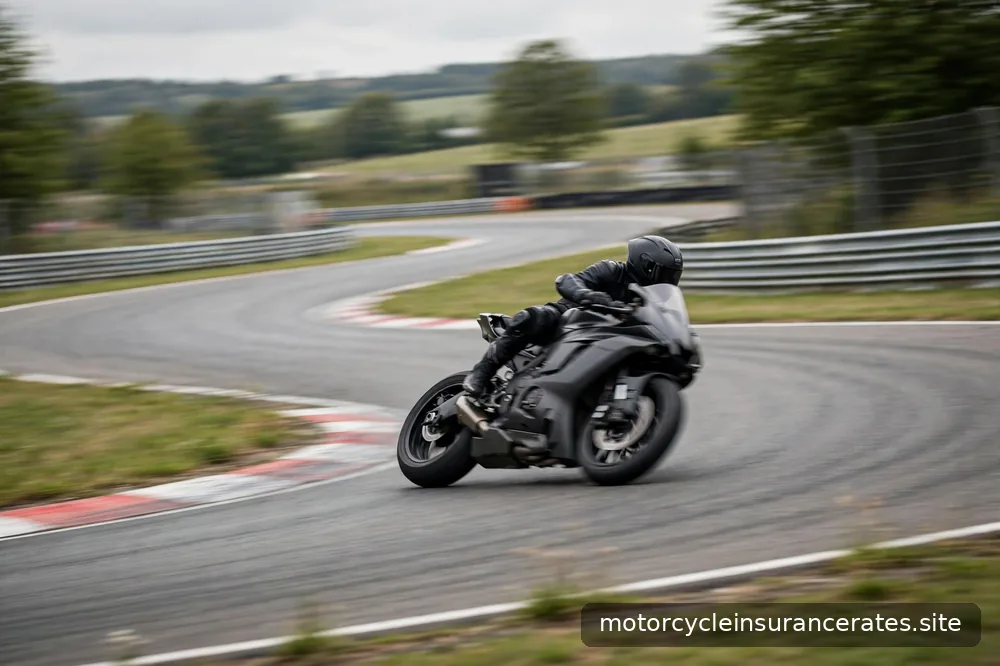
Track Days, Stunts & Racing: What’s Excluded From Your Policy
Taking your bike to the track changes what your insurance covers — usually to nothing. This guide decodes the racing exclusion, explains where track days fall, and shows you how to read your own policy's exclusions.
Standard motorcycle policies typically exclude racing, speed contests, timed events, and stunting. Crash at a track day and the policy that protects you on public roads will very likely pay nothing. This guide explains exactly where the exclusion’s boundaries lie.
Key takeaways
Racing and speed-contest exclusions are standard in motorcycle policies — they apply to organized racing, timed events, and usually track days.
“Track day” means one thing to riders and another to insurers — your policy cares about timing, competition, and closed-course use, not what the event is called.
Stunting is excluded as intentional risky activity, separate from the racing exclusion — wheelies, stoppies, and burnouts on public roads get no coverage for resulting damage.
Specialty track-day coverage exists as a separate product — it is not an endorsement you add to a street policy.
The exclusions section of your policy is short and readable — ten minutes there answers this question definitively for your policy.
Every standard motorcycle policy contains an exclusions section — the part that lists what the policy will not cover. In virtually all of them, you’ll find language excluding bodily injury and property damage arising from the use of the motorcycle in racing, speed contests, stunt activities, or while practicing or preparing for any of these.
The wording varies by insurer, but the structure is consistent: it excludes liability (damage you cause to others during these activities), collision (damage to your own bike), and often comprehensive and medical benefits too. It’s a near-total carve-out — not a reduced benefit, but no benefit.
Insurers price street policies for street risk — commuting, touring, weekend rides. Closed-course riding and stunting produce loss patterns the street premium was never priced to absorb, so insurers exclude the risk and let the specialty market handle it.
The important thing to understand is that this exclusion is activity-based, not location-based. It doesn’t say “not covered at racetracks.” It says “not covered while racing” — and then defines racing broadly enough to capture most of what riders do on closed courses. That distinction is where the confusion — and the denied claims — live.
What counts as racing to an insurer
Riders and insurers use the same words to mean different things. Here’s how the insurer’s definitions typically break down:
Organized racing is the clearest case: sanctioned events with competitors, positions, winners, and prizes. Road racing, drag racing, flat track, motocross — if there’s a starting grid and a checkered flag, every standard policy excludes it. Nobody disputes this one.
Speed contests and timed events are the broader category that catches more riders. Many exclusions explicitly name “speed contests” and “timed events” alongside racing. A timed lap — even at a non-competitive track day where you’re “just riding for fun” — can fall squarely into “timed event” language. The insurer’s logic: timing creates competitive incentives, and competitive incentives change behavior.
Practice and preparation are often named in the exclusion too. Riding a closed course to practice for a race, testing and tuning for competition, or participating in qualifying sessions — excluded even though no trophy is on the line that day.
Closed-course use generally is where the broadest policy wordings land. Some exclusions go beyond racing and timing to exclude any use on a closed course, race facility, or “surface not intended for public vehicular traffic.” Under that wording, even an untimed, non-competitive track session is excluded by location alone.
The practical upshot: the wording of your policy’s exclusion — not the event’s marketing — decides. The section below shows you how to read it.
Track days: the gray zone that isn’t gray
“Track day” is the phrase that generates most of the confusion, because it covers a wide range of actual activities:
Instructional / non-timed track days run by riding schools, with coaches, classroom sessions, and no lap timing. Riders often assume these are covered because they’re educational.
Open track days where experienced riders circulate freely, sometimes with timing available.
Timed track sessions that function as informal competition.
Here’s the uncomfortable truth: most standard policies exclude all three. The instructional day may feel like a safety course, but to the insurer it’s closed-course motorcycle use — and many exclusions capture that either through racing/timed-event language or through closed-course language. The “but it was educational” argument has no standing against the policy wording.
Track days are widely described as the safe way to ride fast — corner workers, no oncoming traffic, runoff areas. True for physical safety, but coverage isn’t about absolute safety; it’s about whether the activity matches the risk the premium was priced for.
There’s a second, subtler trap: the ride to and from the track. Your street policy covers the public-road portions of the day normally. But if the bike is damaged at the facility — in the paddock, in a tip-over in pit lane, on the track — the exclusion applies to that incident regardless of what happened on the highway that morning.
If any of this affects how you think about protecting the bike itself, our comparison of collision vs. comprehensive coverage explains what those coverages do on the street — and, by extension, what you’re without on the track.
Stunts, wheelies, and public-road showboating
Separate from the racing exclusion, standard policies also exclude stunt activities — and this one applies on public roads, where most stunting actually happens.
What counts as stunting in policy language is typically described as intentional maneuvers that create unusual risk: wheelies, stoppies (endo), burnouts, and similar deliberate exhibitions of bike control. The key word is intentional. A wheelie you chose to do is treated differently from a slide you didn’t choose.
The consequences are twofold. First, damage from stunting is excluded — loop a wheelie and the resulting damage to your bike isn’t covered under collision, and damage you cause to others isn’t covered under liability. Second, stunting that leads to a police report creates a paper trail that can affect your record, your rates, and your insurability — reckless-driving citations are among the violations insurers weigh heavily.
Some riders assume that because a maneuver demonstrates skill, it’s somehow defensible. Insurers don’t grade on skill. The exclusion turns on whether the activity was a deliberate stunt, not on whether you pulled it off cleanly.
There’s a social-media dimension too: publicly posted stunt content is dated, timestamped evidence of excluded activity, and adjusters can look at it if a later claim overlaps.
Specialty track-day coverage: the separate product
The existence of the exclusion doesn’t mean track riding is uninsurable. It means it’s insured separately.
Track-day insurance is a specialty product offered by a small number of providers, typically covering physical damage to your own bike during track-day events — usually on a per-event or per-day basis. It is not an endorsement or rider you add to your street policy; it’s a standalone purchase with its own terms, its own exclusions, and its own claims process.
What to know about it:
It covers the bike, not you. Most track-day policies are physical-damage-only — they pay for damage to the motorcycle. Liability for injury to others and medical coverage for yourself are typically not included or are sharply limited. Read the terms; don’t assume.
Event eligibility matters. Providers usually maintain lists of eligible organizations and facilities. An event at an unlisted facility, or run by an unlisted organizer, may not qualify.
It’s priced per event, and the cost reflects the real risk — it will not feel like a bargain next to your street premium. That’s the point: it’s priced for actual track risk.
Your street policy still handles the street. The two products coexist: street policy for public roads, track-day policy for the event. Neither covers the other’s territory.
The market is small and providers change — research current options close to your event date rather than relying on old forum threads.
For riders who do have an incident at the track and need to understand the standard claims process for comparison, our step-by-step guide to filing a motorcycle insurance claim covers how claims work when coverage does apply.
How to read your own exclusions
Everything above describes typical policy language. Your policy is the only one that governs your coverage, and reading its exclusions takes about ten minutes. Here’s how:
1. Find the exclusions section. It’s usually a standalone section in the policy jacket, sometimes repeated per coverage part (liability exclusions, collision exclusions, etc.). Look for headings containing “Exclusions.”
2. Read the racing/speed-contest language word by word. Note exactly which terms appear: racing, speed contest, timed event, stunt activity, closed course, practice, preparation. The specific nouns matter — “timed event” captures more than “racing” alone.
3. Check whether the exclusion is per-coverage or blanket. Some policies exclude racing under liability but have slightly different wording under collision. Know which of your coverages are affected.
4. Look for definitions. Policies often define key terms (“racing,” “stunt”) in a definitions section. The definition controls, not your everyday understanding of the word.
5. Note what isn’t excluded. The exclusions tell you what’s out; everything else in the coverage grants is in. “Racing and speed contests” alone is narrower than wording that adds “any closed course” — though still broad enough for timed events.
6. Ask your agent about ambiguity — in writing. If a phrase is genuinely unclear, email your agent for clarification and keep the reply. Verbal assurances are worth nothing at claim time; a written answer from the insurer is worth quite a bit.
This same read-your-policy discipline applies to every coverage question. Our glossary translating motorcycle insurance terms into plain English is a useful companion for the jargon you’ll meet in those pages.
Frequently asked questions
Does my motorcycle insurance cover me at a track day?
Almost certainly not. Standard policies exclude racing, speed contests, timed events, and usually closed-course use — which covers essentially all track-day formats. Read your policy’s exclusions section for the exact wording; don’t rely on what the event organizer tells you about insurance.
What about a non-competitive, instructional track day with coaches?
Still typically excluded. The exclusion turns on the activity and location (closed-course motorcycle use, often with timing available), not on whether the event is competitive or educational. Some riders are surprised by this; the policy wording is the final word.
If I crash on the way to the track, am I covered?
Yes — the public-road portion of your trip is normal street use, covered under your standard policy. The exclusion applies to incidents arising from the excluded activity itself, not to the entire day.
Does the racing exclusion affect my liability if I injure someone at the track?
Yes — the exclusion typically applies to liability too, so damage or injury you cause to others during excluded activities isn’t covered. Track incidents can involve other riders’ expensive bikes and serious injuries, which makes this the most financially dangerous part of the exclusion.
Can I buy an endorsement to add track coverage to my street policy?
Generally no. Track-day coverage is a separate specialty product, not an endorsement on a standard policy. If an insurer or agent offers you something labeled as track coverage, read it as its own contract with its own terms.
Will my insurer find out if I do track days?
They might — through a claim, social media, event photos, or your own mention. But the real question isn’t whether they’ll find out; it’s whether you’d have coverage when you need it.
Your concrete next step
Pull out your policy’s exclusions section tonight — the actual document, not the marketing summary — and find the racing/speed-contest/stunt language. Read it word by word and note exactly which terms it uses. If you ever plan to ride a closed course, that paragraph is the most important one in your entire policy, and understanding it now beats discovering it in a claims adjuster’s denial letter.
Motorcycle Insurance Compass publishes general educational information about insurance. Nothing here is insurance, legal, or financial advice for your situation. Policy language varies by insurer and state — read your own policy and talk to a licensed agent about your specific needs.