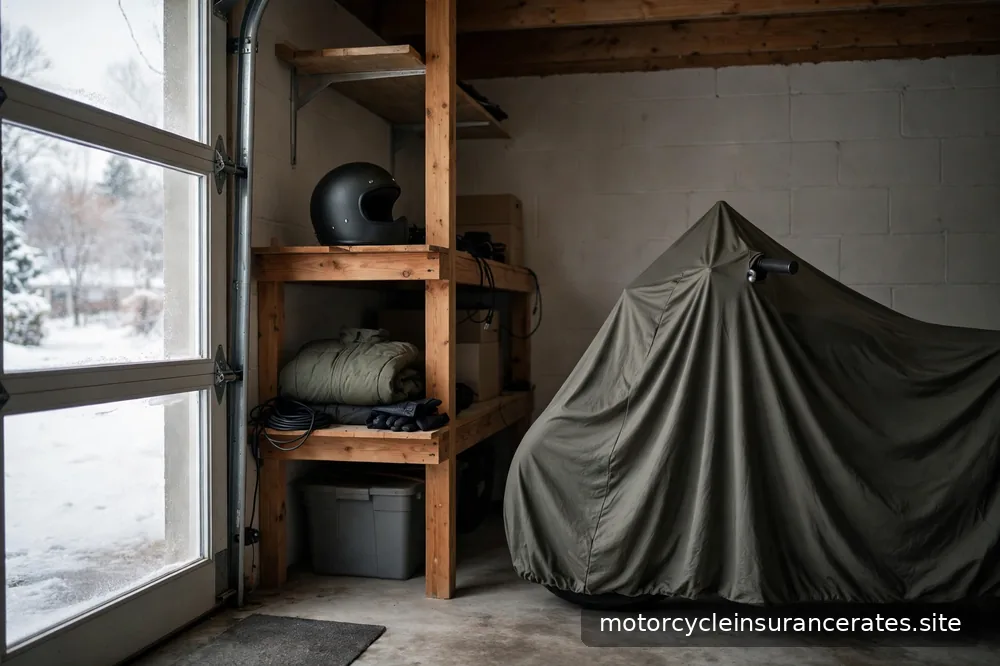
Seasonal Riding: Storage, Lay-Up Coverage, and Winter Options
If your bike sits all winter, paying full price for a policy you can't use stings. This guide explains lay-up coverage, compares your three winter options honestly, and gives you a spring reactivation checklist.
Lay-up coverage scales a motorcycle policy back for the months you don’t ride — typically keeping comprehensive protection (theft, fire, weather) while pausing collision and liability. It’s the middle path between paying full price all winter and cancelling outright. Availability and savings depend on your insurer, state, and storage months.
Key takeaways
Lay-up (storage) coverage is a reduced winter policy — usually comprehensive-only, so theft, fire, vandalism, and weather damage stay covered while the bike is parked.
You have three real options: full coverage year-round, lay-up for the off-season, or cancelling outright — each with honest trade-offs.
Cancelling outright is the riskiest move: the bike sits uninsured against theft and fire, and a coverage gap can complicate your next policy.
If the bike is financed, the lender usually decides for you — most require full coverage year-round.
Spring reactivation needs a checklist, not just a phone call — coverage, registration, and the bike itself all need attention.
Motorcycle policies are built from separable coverage parts, and lay-up coverage is a seasonal adjustment: for stored months, you drop what you don’t need (collision and liability) and keep what still matters (comprehensive — theft, fire, vandalism, falling objects, weather).
Insurers use different names for it — lay-up coverage, storage coverage, winter lay-up, comprehensive-only — and the details vary by company and state. Some insurers offer it as a built-in seasonal option; others require you to manually adjust coverages twice a year; a few don’t offer it at all. The concept is the same everywhere: pay for protection against what can still happen to a parked bike, and stop paying for protection against riding risks that aren’t happening.
The savings come from the paused coverages, not a special discount — but no honest source can quote a fixed percentage, because the effect depends on your insurer, state, and policy structure.
One boundary: the bike must genuinely stay parked. A mid-winter ride while collision and liability are paused is an uninsured ride.
Your three winter options, compared
Every rider in a cold climate faces the same fork in the road each fall. Here’s the honest comparison.
Option 1: Full coverage year-round. You change nothing. The bike is protected against everything your policy covers, all winter, and there is zero administrative work. The downside is purely financial: you’re paying for collision and liability during months when the bike can’t realistically be ridden. For riders in mild climates, year-round riders, or anyone whose bike might see a surprise warm-weather ride, this is the simplest and often the most sensible choice.
Option 2: Lay-up (storage) coverage for the off-season. You call your insurer or agent in the fall, switch to a reduced policy (typically comprehensive-only), and switch back in the spring. The bike stays protected against the things that threaten parked bikes — theft is the big one, plus fire, vandalism, and weather — while you stop paying for riding coverages. The trade-offs: two administrative steps per year, the discipline to keep the bike parked, and confirming your insurer’s process — most require the manual switch.
Option 3: Cancelling the policy outright. You drop coverage entirely for the winter and buy a new policy in the spring. This is the maximum-savings option on paper — and the maximum-risk option in reality, as the next section explains. It’s also not always the savings people expect: you’ll pay any cancellation or reinstatement fees your insurer charges, and your spring policy is priced fresh, which can erase the winter savings.
There’s no universally right answer. The right choice depends on your climate, your insurer’s options, whether the bike is financed, and how honest you are with yourself about mid-winter rides.
The real risks of cancelling outright
Cancelling feels like the thrifty move, but riders who do it are accepting four risks that the other two options avoid.
The bike sits completely unprotected. Theft doesn’t take the winter off. Neither do garage fires, burst pipes flooding a storage unit, vandalism, or a tree limb coming through the roof. Comprehensive coverage is relatively inexpensive precisely because parked-bike claims are infrequent — but “infrequent” is cold comfort when your uninsured bike disappears from a storage facility in February. Our comparison of collision vs. comprehensive coverage explains why comprehensive is the part worth keeping even when the bike never moves.
A coverage gap can follow you. A gap — even a deliberate one — can affect your next policy’s rating and your eligibility for continuous-coverage benefits. Ask before you cancel rather than discovering it in April.
Re-shopping every spring costs time and attention. Getting a new policy means new paperwork, new payment setup, and re-verifying that your coverages match what you had. Riders who do this annually sometimes discover in June that their spring policy has different liability limits or a missing endorsement they had last year. Memory is an unreliable insurance administrator.
You might ride anyway. This is the human factor, and it’s the most common way cancellation goes wrong. An unseasonably warm weekend in March, a friend’s invitation, a quick test ride after maintenance — and suddenly you’re on an uninsured bike. With lay-up coverage, that ride is still uninsured (collision and liability are paused), but at least the bike itself has theft and fire protection. With cancellation, you have nothing at all.
Cancelling isn’t never reasonable — but it deserves more than a glance at the premium.
The lender question: financed bikes
If you’re still making payments on the bike, the winter-coverage decision may already be made for you. Lenders — banks, credit unions, manufacturer finance arms — almost universally require the borrower to carry full coverage (collision and comprehensive, plus state-required liability) for the entire loan term, including months the bike is stored.
The lender’s collateral is the bike, and they want it protected continuously. Violating the requirement can trigger force-placed insurance (coverage the lender buys and bills you for, usually at an unfavorable price) or technical default provisions in the loan agreement.
Before adjusting anything on a financed bike, read your loan agreement or call the lender — not just the insurer. Some lenders permit a winter reduction with written approval; most don’t. If your bike is paid off, this constraint disappears entirely and the decision is yours alone.
What to confirm before you switch
If you’re leaning toward lay-up coverage, a ten-minute call with your insurer or agent should answer these questions. Ask all of them — the answers genuinely vary.
Does my insurer offer a lay-up or storage option, and what does it include? Confirm exactly which coverages stay and which pause — “comprehensive-only” is typical, but structures and state rules vary.
What are the start and end mechanics? Two calls a year or a seasonal schedule? Any minimum storage period or mid-term change fees? Get the process in writing — an email confirmation beats a memory.
What counts as “stored”? Most insurers expect a garage or storage facility — confirm before you rely on a bike cover on an apartment patio.
What happens if I ride during the lay-up period? Almost certainly that ride isn’t covered for collision or liability — ask anyway, and whether it affects the policy beyond that incident.
How does the change affect my billing? Does the premium adjust mid-term with a refund or credit, or at renewal? How do monthly payments change?
Does my state have any wrinkle? Some states tie registration to continuous liability coverage. Your agent should know — and if they don’t, that’s useful information about the agent.
Riders looking at the bigger cost picture should also read our guide to honest ways to lower motorcycle insurance costs — lay-up coverage is one lever among several, and some of the others work year-round.
The spring reactivation checklist
Switching coverage back on is only half of spring reactivation. Run through the full list before your first real ride:
1. Restore full coverage — in writing. Call your insurer or agent and confirm collision, liability, and any other paused coverages are back in force, with the effective date confirmed by email. Don’t assume the fall change auto-reverses.
2. Verify the details, not just the existence. Check that your liability limits, deductibles, and any endorsements (custom parts, accessory coverage) match what you had last riding season. Policies renewed over the winter sometimes come back with changes.
3. Check registration and inspection. Some states require current registration and safety inspection regardless of riding season. A bike that sat all winter may have an expired sticker you’d forgotten about.
4. Inspect the bike itself. Tires lose pressure, batteries die, fluids age, brakes can seize, rodents chew wiring. Do a full pre-ride inspection — tires, brakes, lights, fluids, chain or belt, controls — before the first ride.
5. Re-check your gear. Helmets have a service life, and any drop or impact retires one immediately. Check jacket armor, gloves, and boots — gear degrades in storage too.
6. Ease back in. Skills fade over a winter off. Your first rides should be low-traffic familiarization, not an ambitious first-day tour — a parking-lot refresher each spring is genuinely good advice.
7. Update your documents. Make sure the current insurance card is on the bike (or in your phone, per your state’s rules) and that your emergency contacts and roadside assistance details are current.
Our winter lay-up reminder walks through this same seasonal cycle from the fall perspective — the two guides are designed to bookend your off-season.
Frequently asked questions
Is lay-up coverage the same as cancelling my policy?
No. Lay-up keeps the policy active with reduced coverages (usually comprehensive-only), so theft, fire, and weather stay covered. Cancelling ends the policy entirely — zero protection plus a coverage gap in your history.
Will lay-up coverage save me money?
Usually — you’re not paying for collision and liability during the storage months. But no honest source can quote a fixed figure; it depends on your insurer, state, bike, and storage months. Ask your insurer for your specific numbers.
Can I still ride occasionally during the lay-up period?
Not with coverage. While collision and liability are paused, any riding is uninsured for those coverages. If your winters include rideable days, full year-round coverage is the honest choice — or ask your insurer whether they offer a flexible option.
Does lay-up coverage affect my registration?
It can, depending on your state. Some states require continuous liability insurance on registered vehicles and may flag or penalize a lapse. Ask your agent about your state’s rules before reducing coverage — this is one of the questions too many riders skip.
What if my bike is stored at a facility rather than my garage?
Tell your insurer where the bike is stored. The garaging location is a rating factor on many policies, and a storage facility address may change your premium — sometimes favorably, sometimes not. Either way, the policy should reflect reality.
Should I drop coverage entirely if the bike is old and paid off?
An older bike costs less to insure, which weakens the case for lay-up gymnastics — but its comprehensive coverage is also inexpensive, and theft doesn’t check the odometer. Weigh the actual premium against the actual risk.
Your concrete next step
Before the weather turns, call your insurer or agent — not the internet — and ask: “What are my options for reducing coverage while my bike is stored, and what exactly stays covered?” Write down the answer, including the spring switch-back process. The only lay-up rules that matter are the ones in your policy, in your state.
Motorcycle Insurance Compass publishes general educational information about insurance. Nothing here is insurance, legal, or financial advice for your situation. Coverage options, state rules, and lender requirements vary — read your own policy and talk to a licensed agent about your specific needs.