Your motorcycle insurance rate is the output of a rating formula with many inputs. This guide walks through each factor — from engine size to garaging — in plain English, explaining how they combine and which ones you can actually influence.
Your motorcycle insurance rate is not a number someone made up — it is the output of a rating process with many inputs. Insurers weigh your bike, your age and experience, your record, where you live and keep the bike, how much you ride, and what coverage you choose. Understanding each input is the first step to understanding your price.
Key takeaways
Rates come from rating factors, not vibes. Every insurer uses a set of inputs about the bike, the rider, and the coverage to compute a premium.
The bike matters enormously. Type, engine size, and value are among the heaviest-weighted factors — a sport bike and a cruiser are rated like different species.
You are rated too. Age, years licensed, training, and your driving record all feed the formula.
Where and how the bike lives counts. Location, garaging, and annual mileage change the risk picture.
The formula itself is proprietary. You can understand every input and still not reproduce the exact price — but you can predict its direction.
Insurance pricing starts from a simple premise: riders who are statistically more likely to generate claims, and more expensive claims, pay more. Everything else is detail about how insurers estimate that likelihood for you specifically.
Each insurer builds its own rating formula — actuaries feed it years of claims data, and it spits out a premium for a given rider-bike-coverage combination. The formulas are proprietary and differ between companies, which is why the same rider gets different prices from different insurers. But the inputs are broadly the same across the industry, and they are published openly in insurer educational material and by the Insurance Information Institute.
Think of it as a recipe where every company uses roughly the same ingredients in different proportions. Learn the ingredients and you can read any quote intelligently. If you want the shopper’s-eye view of the same material, our guide to how much motorcycle insurance costs reframes these factors around the price question.
The bike: type, engine size, and value
The motorcycle itself is one of the heaviest inputs — often the heaviest. Three aspects of the bike matter:
Bike type and class. Insurers group motorcycles into classes — sport, cruiser, touring, standard/naked, dual-sport/adventure, scooter — because claims data shows the classes behave differently. Sport bikes, as a class, generate more frequent and more severe claims than cruisers; that pattern shows up in published loss research from the Highway Loss Data Institute, which tracks insurance losses by motorcycle class. The class difference alone can move a rate dramatically. Our class-by-class explainer on sport bikes vs. cruisers vs. touring goes deeper on why each class is priced the way it is.
Engine size and performance. Larger, more powerful engines correlate with higher speeds and more severe crashes. Many insurers use engine displacement bands (often expressed in cc) as an explicit rating input — a 1000cc supersport is rated very differently from a 300cc starter bike. This is one reason experienced riders advise beginners to start small: the insurance savings are real, even if no fixed amount can be quoted as fact.
Bike value. Collision and comprehensive coverage protect the bike itself, so a more expensive bike costs more to insure for those coverages — there is simply more value at risk. A $20,000 touring bike carries more comprehensive exposure than a $4,000 used standard. Custom parts and accessories add another layer; factory coverage typically stops at factory parts.
The rider: age, experience, and training
After the bike, the rider is the next big input — and this is the one new riders feel most sharply.
Age. Younger riders pay more, and the reason is actuarial, not personal: riders in their teens and early twenties, as a group, have less experience and worse loss outcomes. Rates typically ease as riders move into their late twenties and beyond, assuming a clean record. This isn’t a judgment on any individual young rider’s skill — it’s how group rating works.
Years licensed and riding experience. Time in the saddle matters independently of age. A 40-year-old with six months of riding experience is rated differently from a 40-year-old with fifteen years. Insurers ask how long you’ve been licensed to ride a motorcycle specifically — car driving history helps, but motorcycle experience is its own input.
Training. Completing a recognized rider safety course, such as the MSF Basic RiderCourse or a state-approved equivalent, is a positive signal many insurers recognize — some with a discount, some simply as a favorable rating factor. The key honesty: recognition and any discount vary by insurer and are not universal, so confirm with your insurer before enrolling.
The record: tickets, accidents, and claims
Your driving and riding record is the insurer’s window into your future behavior — the best predictor of future claims is past claims and violations.
Traffic violations. Speeding tickets, reckless driving citations, and DUIs raise rates because they predict crash involvement. Minor violations typically affect rates for a few years; serious ones (DUI, reckless) affect them more and longer. Exactly how long varies by insurer and state — there is no universal surcharge schedule, despite what internet forums claim.
At-fault accidents. An at-fault crash — in a car or on a bike — signals higher future risk and is typically surcharged at renewal. Not-at-fault accidents generally affect rates less or not at all, though practices vary.
Prior claims. A history of filed claims, especially at-fault ones, marks you as a higher-frequency claimant. This is also why riders sometimes pay small losses out of pocket rather than filing: each claim becomes part of the record that future premiums are computed from.
Lapses and continuity. Continuous coverage history is a mild positive signal; a lapse in coverage can be a negative one. Keeping a policy active — even a minimal or storage policy during off months — generally rates better than cancelling outright and restarting.
The setting: location, garaging, and mileage
Where the bike lives and how it’s used round out the risk picture:
Location. Rates vary by state and by ZIP code within states. Denser traffic areas mean more crash exposure; some areas have higher theft rates. State law also matters — required coverages differ, and some states allow rating factors (like credit-based insurance scores) that others restrict or ban. Location is one input you mostly can’t change, but it explains a lot of the “why does my friend in another state pay less” mystery.
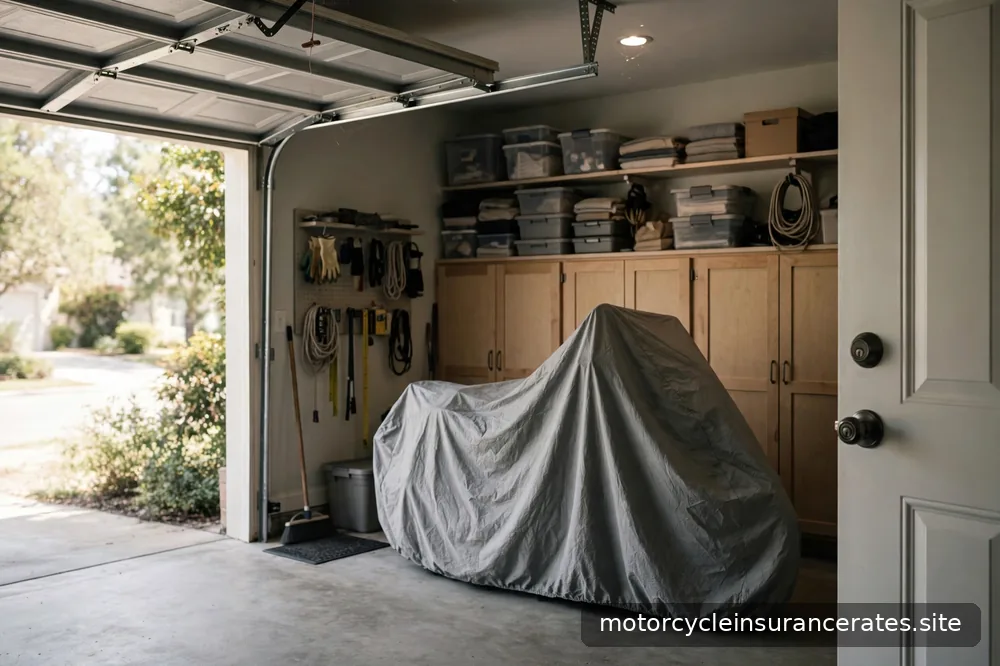
Garaging. Where the bike sleeps at night is a real rating input. A locked garage beats a carport; a carport beats street parking — primarily because of theft and vandalism exposure, which is comprehensive coverage’s main peril. If you move the bike into a garage, tell your insurer; it’s one of the few rating inputs you can improve in an afternoon.
Annual mileage. More miles mean more exposure — more time in traffic, more chances for something to go wrong. Insurers ask for estimated annual mileage, and lower-mileage riders (weekend-only, seasonal) generally rate better than daily high-mileage commuters. Estimate honestly; a big underestimate discovered at claim time helps no one.
The coverage: limits, deductibles, and add-ons
Finally, the price depends on what you’re actually buying:
Liability limits. Higher limits cost more — you’re buying more protection. But the relationship isn’t linear: doubling your limit doesn’t double your premium, because the additional risk covered by the higher layer is smaller than the base layer. This is worth knowing when you weigh whether higher limits are “worth it.”
Deductibles. The deductible is what you pay out of pocket before collision or comprehensive pays. Higher deductibles mean lower premiums — you’re retaining more of the small-loss risk yourself. The trade-off is real: choose a deductible you could actually pay tomorrow without hardship.
Add-ons and endorsements. Custom parts coverage, roadside assistance, trip interruption, gear coverage — each adds premium. They’re priced à la carte, so only buy the ones whose risk you’d actually want transferred.
Discounts and credits. Multi-policy (bundling with auto or home), paid-in-full, paperless, anti-theft devices, and safety-course completion are common discount categories — each insurer’s list and amounts differ, and some discounts exist at one company but not another. Our nine honest ways to lower costs walks through each lever with its trade-offs.
How the factors combine
Here’s the part that surprises people: the factors don’t simply add up. Insurer rating formulas use interactions — a young rider on a sport bike isn’t just “young factor + sport factor”; the combination is riskier than the sum, and the formula knows it. Conversely, a mature rider with decades of experience on a small cruiser, garaged, low mileage, clean record — the favorable factors compound too.
This interaction is also why “which single factor matters most” has no universal answer. For a 19-year-old, age dominates. For a 45-year-old on a superbike, the bike dominates. For anyone, the record can swamp everything else after a DUI.
And it’s why quotes differ between insurers: each company’s formula weights the inputs differently and slices the interactions differently. Two insurers can look at the identical rider and bike and disagree by a wide margin — they’re different statistical models. The practical consequence is the oldest honest advice in insurance: compare quotes with identical coverage inputs, because the price difference is telling you about the companies’ models, not about you.
What varies — and what to verify
A few honest boundaries on everything above:
Every factor’s weight varies by insurer. “Garaging matters” is universal; how much it matters is company-specific.
State law shapes the formula. Required coverages, allowed rating factors, and discount rules differ by state. Your state’s insurance department site is the authority on what’s allowed where you live.
No fixed percentages or dollar amounts in this guide are stated as fact because none exist universally. Any article that tells you “a speeding ticket raises rates by exactly X%” is inventing precision that doesn’t exist.
Your quote is the only real number. Everything here teaches you to read and predict quotes — the quote itself is computed from your insurer’s live formula.
Frequently asked questions
Which factor affects my motorcycle insurance rate the most?
It depends on your profile — for young riders it’s usually age and bike choice; for experienced riders it’s usually the bike and the record. No single factor dominates for everyone, which is why insurers use multi-factor formulas.
Can I get a rate without giving all this information?
Any real quote needs the core inputs (bike, rider, location, coverage). “Instant quotes” that ask three questions are estimating with averages — the real price comes after the full picture.
Do all insurers use the same factors?
Broadly yes on the inputs, no on the weights. The factor list is an industry standard; each company’s formula — how much each factor counts and how they interact — is proprietary.
Will my rate go down automatically as I get older?
Age helps, but it’s not automatic — your record, bike choice, and coverage decisions matter alongside it. A clean record compounding with age is what produces the decreases riders hope for.
Why did my renewal go up when nothing changed?
Renewal pricing reflects updated claims data, not just your personal history. If your bike class or area got riskier in the insurer’s data, your rate can rise even with a clean record. This is also a good moment to shop with identical limits.
Your concrete next step
List your own rating inputs on one page: bike (type, engine size, value), you (age, years licensed, training completed), your record (violations/claims in the last five years), your setting (location type, garaging, annual mileage), and your coverage (limits, deductibles). Then get two quotes with identical coverage and compare them factor by factor. You’ll understand both your price and the market — which is exactly what this knowledge is for.
Motorcycle Insurance Compass publishes general educational information about insurance. Nothing here is insurance, legal, or financial advice for your situation. Rating factors and their weights vary by insurer and state — talk to a licensed agent about your specific needs.