Winter Lay-Up Reminder: Storage Insurance Options Before You Park the Bike
Before the bike goes into storage, make the insurance decision deliberately. Lay-up vs. full coverage vs. cancelling — the trade-offs, the lender constraint, and what to do in spring.
Parking season is here, and before the bike goes under its cover you have an insurance decision to make — full coverage, lay-up coverage, or cancelling outright. Each has honest trade-offs, one has a lender-shaped constraint, and all deserve twenty minutes of your attention before the first frost.
Key takeaways
Three options, no default winner: full coverage year-round, lay-up/storage coverage, or cancelling — the right choice depends on your climate, lender, insurer, and honesty about mid-winter rides.
Lay-up usually means comprehensive-only — theft, fire, vandalism, and weather stay covered while collision and liability pause.
Financed bikes usually can’t lay up — lenders typically require full coverage for the entire loan term; check the loan agreement first.
Cancelling outright is the riskiest option — zero protection all winter plus a coverage gap in your history.
Whatever you choose, document it and plan the spring reversal now — the riders who get hurt are the ones who forget what they did in October.
A parked bike faces a different risk profile: no collision or liability exposure, but ongoing theft, fire, vandalism, and weather risk. Lay-up coverage matches that profile; full coverage buys simplicity; cancelling accepts the exposure. Choose deliberately — drifting into the least-thought option is how riders cancel by accident.
Option 1: Full coverage year-round
Keep everything exactly as it is. The policy continues unchanged through the winter months.
The case for it: zero admin, no spring-restoration risk, continuous coverage history, and full protection if winter surprises you — a warm February weekend, an early shakedown ride. Where winters produce rideable days, this stops being the “lazy” choice and becomes the correct one.
The case against it: cost. You’re paying for collision and liability during months when the bike is overwhelmingly likely to sit still. For riders in genuinely cold climates with a hard parking season (say, November through March), that’s four-plus months of premium buying protection against risks that aren’t occurring.
Who it’s for: year-round or shoulder-season riders; riders in mild climates; riders who can’t trust themselves not to take a mid-winter ride; anyone who values simplicity over optimization; and — per the lender section below — most riders with financed bikes.
Continuous full coverage is also the simplest insurance history: no changes, no gaps, nothing to explain at renewal. Boring is underrated in insurance.
Option 2: Lay-up (storage) coverage
Reduce the policy for the storage months — typically to comprehensive-only — and restore full coverage in spring.
How it works mechanically: collision and liability pause (or drop to minimums, per your insurer’s structure and state rules); comprehensive stays. The bike remains protected against parked-bike risks — theft above all, plus fire, vandalism, weather. Reverse it in spring.
The savings: real but variable — you’re not paying for paused coverages during storage months. No honest source can quote a fixed figure; it depends on your insurer, state, bike, and storage months. Ask your insurer for your specific numbers.
The requirements and catches:
Your insurer has to permit it — most do in some form; a few don’t. Ask.
The bike has to actually stay parked. A mid-winter ride on paused collision and liability is an uninsured ride. Be honest with yourself about your winters before choosing this.
Two documented steps per year — fall reduction and spring restoration, with effective dates confirmed in writing.
State wrinkles exist — some tie registration to continuous liability coverage. Ask your agent directly.
Who it’s for: riders in cold climates with a genuine multi-month parking season, paid-off bikes, insurers that offer a clean lay-up option, and riders disciplined enough to keep the bike parked and to execute the spring reversal.
Our full guide to seasonal riding, storage, and lay-up coverage walks through this option in depth — including the ten-minute question list for your insurer and the complete spring reactivation checklist.
Option 3: Cancelling outright
End the policy for the winter; buy a new one in spring.
The case for it: maximum premium savings on paper. No policy, no premium — for the storage months, the insurance cost is zero.
The case against it — and it’s a substantial case:
Zero protection all winter. Theft, fire, vandalism, weather — the full catalog of parked-bike risks, entirely on you. Comprehensive is among the least expensive parts of a policy; cancelling to “save” it is backwards economics.
A coverage gap in your history. A gap — even planned — can affect your next policy’s rating and continuous-coverage eligibility. Ask before you cancel.
Reinstatement friction. New paperwork, new payment setup, new declarations to verify — every spring. Annual re-shoppers sometimes discover mid-summer the new policy doesn’t match the old.
The uninsured-ride trap. With lay-up, a mid-winter ride is uninsured for collision/liability but the bike keeps theft/fire protection. With cancellation, that ride has nothing.
Who it’s for, honestly: paid-off, low-value bikes in highly secure storage, riders who accept the risks with eyes open and genuinely won’t ride all winter. Legitimate for that narrow profile — a careless default for everyone else.
One more consideration: some cancellers discover the spring policy costs more than expected — new-business rating, lost loyalty benefits, market movement. Price the full cycle before assuming savings.
The lender constraint — check this first
Making payments? Read this first: your lender probably requires full coverage year-round, overriding your preference.
Lenders almost universally require full coverage (collision, comprehensive, state-required liability) for the entire loan term, storage months included — their collateral, their rules.
Violating the requirement can trigger:
Force-placed insurance — the lender buys coverage on your behalf and bills you for it, typically at a price that makes your current premium look like a bargain.
Loan agreement consequences — most agreements treat insurance maintenance as a borrower obligation; persistent violation can create default exposure.
Before adjusting anything on a financed bike: read the loan agreement or call the lender. Some permit a documented winter reduction with prior written approval; most don’t — get permission in writing. Even if your insurer offers lay-up, your lender can prohibit it.
Paid-off bike? This entire constraint evaporates, and the decision is fully yours.
Storage prep: the bike and the paperwork
The insurance decision is half the winterization; the bike itself is the other half. Handle both in the same weekend.
The bike:
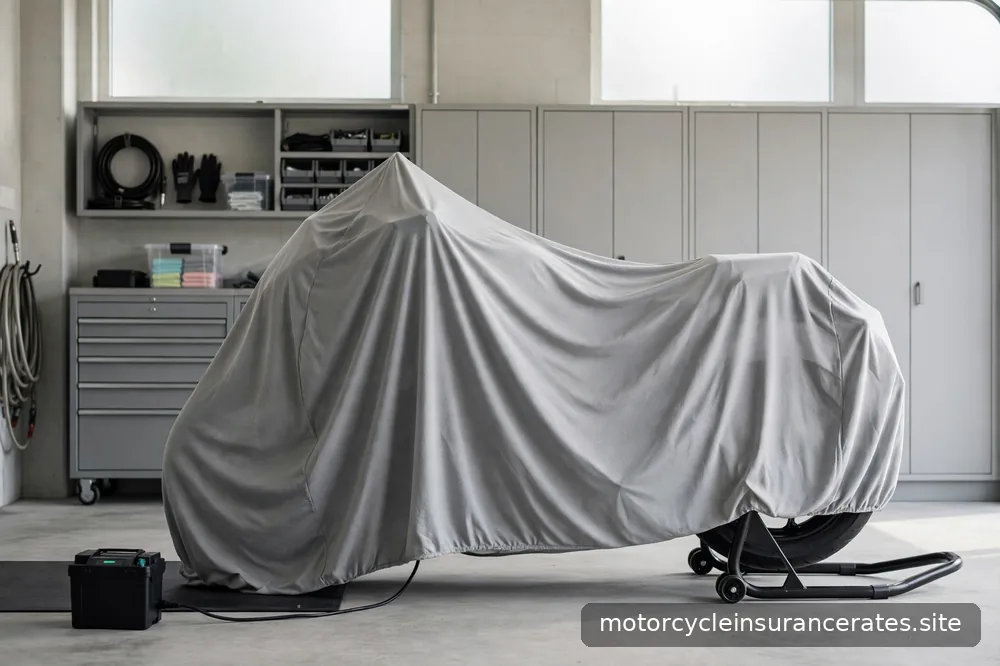
Fuel: fill the tank and add fuel stabilizer, then run the engine briefly to circulate it. A half-empty tank invites condensation and corrosion.
Battery: connect a battery tender (not a trickle charger — a tender). Or remove the battery and store it indoors on a tender.
Tires: inflate to spec and get the bike off cold concrete if possible — paddock stands ideal; otherwise move it periodically.
Fluids: change the oil — used oil’s contaminants shouldn’t sit all winter. Check coolant, brake fluid, final-drive oil.
Clean and cover: wash and dry the bike completely, wax painted surfaces, and use a breathable motorcycle cover — not a plastic tarp, which traps moisture.
Pest prevention: steel wool in exhaust and intake (tag the handlebar so you remember in spring).
Security: disc lock, cover (out of sight helps), and ideally a locked space. Tell your insurer where the bike is stored if the location changed.
The paperwork:
Document the insurance change — save the confirmation email with effective dates. If you laid up, calendar the spring restoration now, not in April.
Photograph the bike — all four sides, odometer, accessories, VIN. Pre-storage documentation smooths any theft or facility-damage claim.
Registration and inspection — check expiration dates. Some riders discover in spring that the registration lapsed mid-winter; handle renewals on your state’s schedule regardless of riding season.
Receipts file — winter is also when riders buy parts and gear for spring projects. Keep receipts with the bike’s file; they’re the documentation for accessory coverage later.
Plan your spring reactivation now
Lay-up’s danger isn’t winter — it’s spring, when the reversal goes wrong. Plan it now:
Calendar it. Put two reminders: one to call the insurer/agent about restoring coverage, one to verify the restoration took effect. Two weeks before your realistic first ride is about right.
Know the restoration process. Is it a phone call? An online form? Does your agent handle it? Confirm the mechanics now, while you’re already talking to them about the fall change.
Budget the spring premium. The restored full coverage may cost more than last year’s — rates move. No surprises.
Pair it with the mechanical recommissioning. Coverage restoration and the bike’s spring inspection belong on the same checklist — our spring tune-up checklist covers the full spring review.
When should I make the winter insurance decision?
A few weeks before your last ride — no gap between decision and action. Deciding in January about a November-parked bike means months of wasted premium or unknowingly uninsured time.
Does lay-up coverage cover me if someone steals the bike from a storage facility?
Yes — theft is a classic comprehensive claim, and storage facilities are common theft locations. Document condition and accessories beforehand, keep the facility receipt, report promptly.
Can I pause my policy instead of changing coverages?
Some offer a formal “suspension” or seasonal option; others just adjust coverages. The label matters less than the mechanics: confirm in writing what’s active during storage.
What if winter is mild and I might ride occasionally?
Then lay-up is probably the wrong choice — it assumes the bike stays parked. Occasional winter rides need full coverage. If your winters are unpredictable, the honest choice is year-round full coverage.
Will a winter lay-up affect my loyalty or continuous-coverage benefits?
It shouldn’t — the policy stays in force; only coverages change. That’s lay-up’s advantage over cancelling. Confirm with your insurer that lay-up counts as continuous coverage.
My bike is old and barely worth anything. Should I just cancel?
Run the numbers: an older bike’s comprehensive is typically inexpensive, and theft doesn’t check Kelley Blue Book. Compare the real winter premium against the real risk — plus the coverage-gap effect on your spring policy.
Your concrete next step
This weekend: (1) check your loan agreement — financed bikes let the lender settle the question; (2) ask your insurer what lay-up options exist on your policy and what they cost; (3) calendar the spring restoration with two reminders. Twenty minutes, one documented decision.
Motorcycle Insurance Compass publishes general educational information about insurance. Nothing here is insurance, legal, or financial advice for your situation. Coverage options, lender requirements, and state rules vary — read your own policy and loan agreement, and talk to a licensed agent about your specific needs.